
How to Fill Out the CATMP Survey
This Section provides suggestions for how interested citizens should respond to the online survey. Please note you have until Wednesday 21 January 2026 to do this.
Some helpful notes:
The good news is that if you wish to comment on the Canmore Area Trails Master Plan as a whole - you only have to read 12 pages! (pp 3-15)
The majority of the document, (pp 15-49), outline details for eight different planning units. The survey allows you to refrain from commenting on all the sections, so you can skip this section if you prefer.
It is essential that you provide written comments in every comment box of the survey, including the very last comment box, including the last comment box, which asks “do you have anything else to share?”
It’s OK to skip comment boxes pertaining to specific Trail Network Improvements (Section 4).
If you agree with our critique of the plan of the Canmore Area Trails Master Plan, feel free to use some version of the text below - important that you use your own words to do this.
In the survey you’ll be asked if you completed the interactive mapping exercise – we recommend you take a look at this. It is a very effective way to specifically endorse planned trail closures, re-iterate the need for ongoing wildlife monitoring to ensure the plan is having the intended effects on wildlife, and to ask for education, enforcement and adaptive management strategies.
Below you’ll see the main survey text, with our responses in boldface.
-
Please indicate your level of support for sections 1-2 of the trails plan. Does each section provide accurate, suitable, and sufficient contextual information to help readers?
Section 1 – Introduction
Somewhat supportive
Section 2 – Existing Trail System and Desired Conditions
Somewhat supportive
If you feel improvements are needed to the content in these sections, please explain why and tell us what could be done to improve it. (255 word limit)
Any successful trails master plan must contain three E’s: Engineering, Education, and Enforcement…
BUT Education and Enforcement are missing from this document!
Without education trail users WON’T
Know if they're on a pirate (unauthorized) trail or a designated/sanctioned trail
Know if they're in / close to a wildlife corridor
Learn the common sense guidelines (dogs on leash, making noise on the trail, etc) that keeps them and wildlife safe.
This Master Plan must include EDUCATION of trail users (why and how to stay off unofficial trails, no dogs off leash, respect closures, bear smart practices etc)
This Master Plan must include ENFORCEMENT of trail closures, dogs off leash, seasonal closures etc
I support all the objectives listed on page 3 – but this document does not show HOW the plan will accomplish these objectives.
Objectives #1, 2, 6, 8, 9, and 10 all speak to ‘management’ - but the Master Plan has nothing on HOW it will be done.
Effective and adaptive management can’t happen without comprehensive monitoring of wildlife movement and trail use. This needs to be included in the Plan
How can this be a ‘Master Plan’ if all this content is missing?
-
Section 3 of the draft trails plan describes the trail planning and design approach to be used throughout the entire area on the topics of:
Shifting recreation and trail free areas
Seasonal closures
Trail bundles
Community loops
Addressing trail experience gaps
Expected habitat improvements
Approach to designating trails
The following questions invite your feedback on each topic and how it is presented.
Section 3 – Trail Planning and Design Approach Please indicate your level of support for the trails plan’s content on this topic. Do you support the proposed approach and how they are presented?
Shifting recreation and trail free areas
Very supportive
Seasonal closures
Very supportive
Trail bundles
Very supportive
Community loops
Very supportive
Addressing trail experience gaps
Very supportive
Expected habitat improvements
Very supportive
Approach to designating trails
Very supportive
If you feel improvements are needed to this section’s content, please explain why and tell us what could be done to improve it (255 word limit)
I support the Desired Conditions (pp 6-7), that describe desired ecological conditions, visitor experience, and trail governance (including adaptive management and monitoring) - but the plan contains NOTHING that shows HOW these desired conditions will be met
I support adding 232 km of new authorized trails AND the permanent decommissioning of 275 km of pirate (unauthorized) trails
Decommissioning is absolutely critical to the success of this Plan - this Plan must commit to that
I strongly support seasonal closures
I support Temporal (ie time of day) closures of some trails as a management tool. Science tell us that wildlife alter their movement patterns to avoid humans - if human use is predictable (say, a nighttime closure), animals will use the area at night
New science tell us about the ‘zone of influence:’ human use of trails negatively affects wolf and bear use of habitat hundreds of metres on either side of trails - so proper management of human use is essential
This plan create the potential for a better experience by trail users AND better outcomes for wildlife, including habitat improvement and less restricted wildlife movement – but ONLY if the Plan is IMPROVED by including key management features. This plan needs to include and commit to:
Education of trail users
Enforcement of appropriate trail use
Monitoring of wildlife and human use
adapting management strategies if the Plan is not fully working
Identifying ‘who will do what’ to look after the trail system in the long term - ie trail governance
-
Please fill out as you see fit (put ‘Unsure’ if you haven’t had time to review) – and don’t forget to fill out the last comment box (please see below)
Before completing this survey, did you complete the interactive mapping exercise?
Yes
Do you have anything else to share about the Canmore Area Trails Master Plan? (500 word limit)
I believe that, properly done, the draft Canmore Area Trails Master Plan is our best chance to improve future prospects for trail users AND wildlife
It is absolutely critical that we get this Plan right - otherwise we risk cutting off the last remaining wildlife corridor connecting Banff National Park and Kananaskis Country. Science tells us we've already LOST 85% of the wildlife connectivity we used to have in this area - WE ARE AT A TIPPING POINT.
We need to do this: wildlife has intrinsic value.
Keeping wildlife in this valley creates economic value for future tourism
The Plan lacks strategies to GET BUY-IN from residents and visitors. Without this buy-in, the plan will fail.
This Trails Master Plan create the POTENTIAL for a better trail system AND better outcomes for wildlife - but without improvement, it will FAIL
The Plan must include…
a human management roadmap, which would include essential education and engagement of trail users (interpretive signage, trail maps, wayfinding, engagement with relevant trail app designers, etc)
a commitment and funding for Enforcement, for those who fail to heed education - but there are severe capacity issues on this front, which the Plan does not address.
commitment to ongoing monitoring of wildlife movement and human use
commitment to adaptive management if goals are not being met
ALL of this important content was included in the March 2025 version but it was removed. IT MUST BE REINSTATED.
The Final Terms of Reference for this initiative (basically, what should be in the master plan) details what the scope of the Master Plan should be (pp. 8-10) -yet the master plan itself contains only a fraction of that information. The government should have followed its very own terms of reference. Both these documents can be found on the government's landing page for this entire initiative.

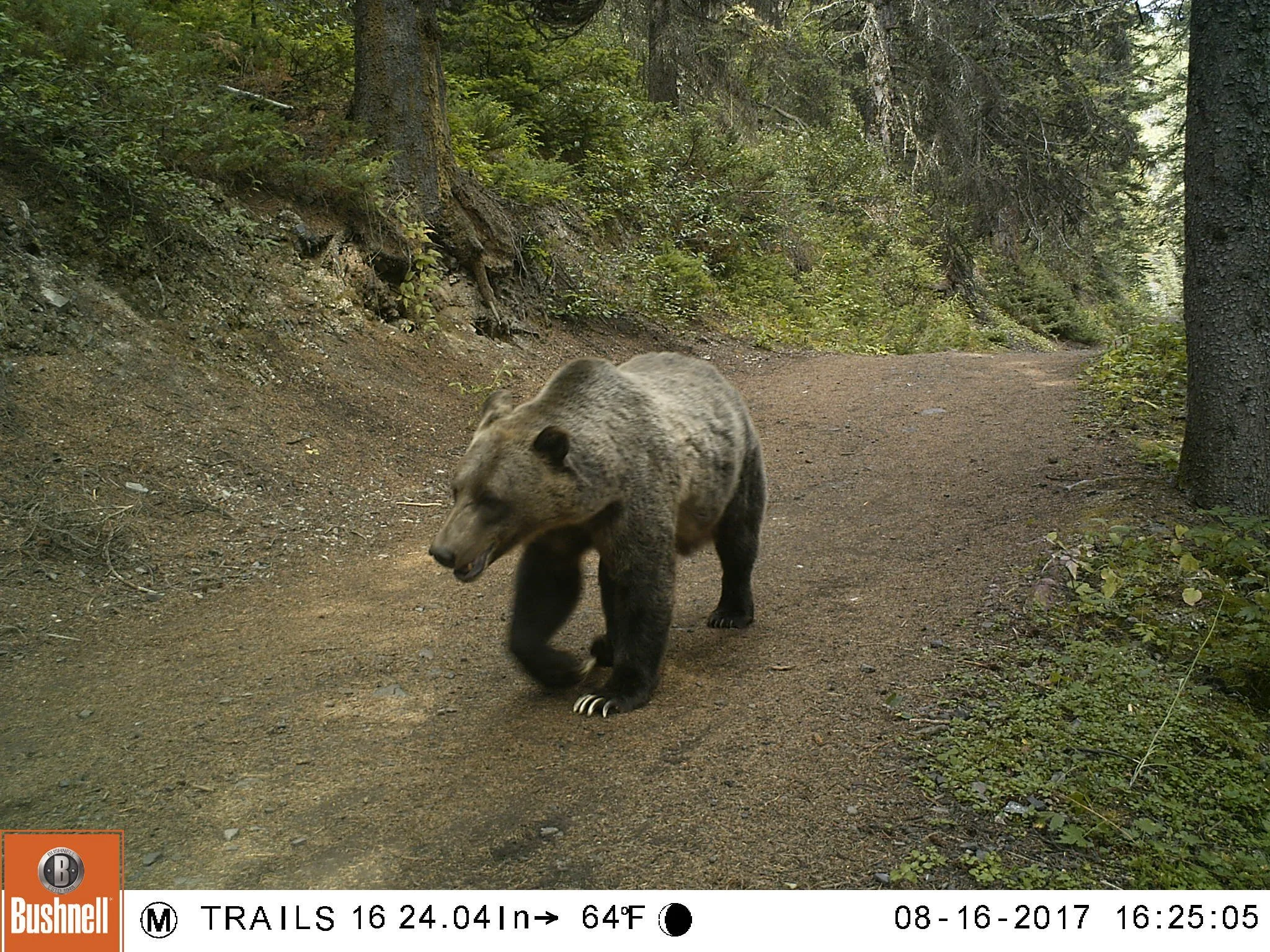
Note the timestamp on each image. Photo credit: Government of Alberta