
Did you know that WildSmart is a program of the Biosphere Institute, a local charity? Our work relies entirely on donations and sponsors. If you would like to support our community-based efforts to promote human-wildlife coexistence, please donate now!
BEAR ACTIVITY UPDATE (Oct.22, 2026)
(Banff National Park East Gate to Bow Valley Provincial Park)
It was another fairly quiet week for bears in the Bow Valley and Kananaskis Country, and the colder weather will likely speed up the process of bears heading into their dens. Although some bears are thinking about hibernating, many are still on the fence and trying to get some last snacks in before they den. Those calories should not be coming from people and bears will be searching for easy food sources. With food getting scarce, it is extra important for campers and day users to make sure NO attractants are left unattended that could attract bears. Remote camera and collar data have shown that some males like to stay out on the landscape into mid-December. Situational awareness is still important when you’re out on the landscape so people need to be thinking about bears and other wildlife, all of which are still active in the Bow Valley and K-Country, and expecting encounters when out recreating.
Bears are opportunistic feeders and will eat anything that is available to them, so please make sure your yard is free of all potential attractants that bears and other wildlife might try to eat - or you may face steep fines and be responsible for killing a bear! Remove or secure ALL wildlife attractants such as fruit (on trees and on the ground), PUMPKINS, bird feeders, unsecured garbage, greasy bbq's and pet food. To find out more about the fines associated with allowing wildlife attractants such as fruit to accumulate on trees and on the ground, view and download the Community Standards Bylaw here.
There have been some questions about fruit trees, so to clarify: fruit trees are any fruit bearing trees and shrubs that people have in their yards that may attract wildlife, including bears. Even though some of these fruit trees may not often have bears feeding in them (or maybe you have never had a bear feeding in your fruit tree), they are still considered wildlife attractants and there is a chance that bears may try to access them. As such, they should be removed and replaced with non-fruit bearing alternatives, or at a minimium, the fruit needs to be removed before it ripens. Even ornamental fruit trees could be enticing for a bear if it was hungry, even if a bear has never fed in it!
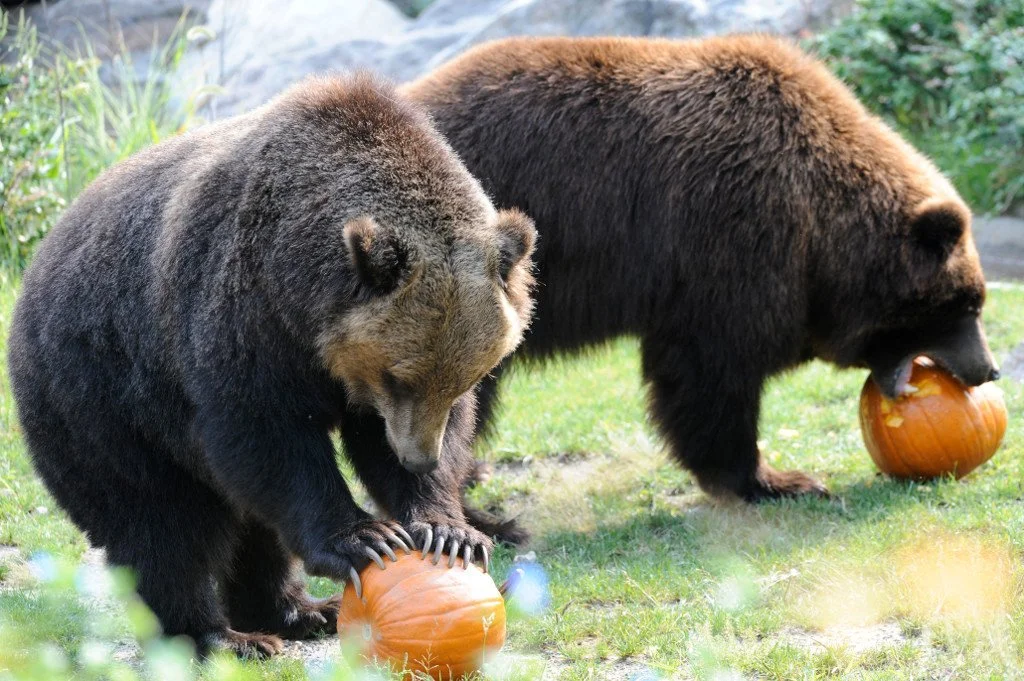
You can help keep bears and other wildlife out of trouble by keeping your pumpkins indoors! It is a very simple act that can keep yourself and your neighbourhood safe! Pumpkins make a tasty meal for a hungry bear trying to fatten up for the winter ahead (pumpkin seeds have 163 calories an ounce; pulp is 50 calories a cup). If you don't want a bear in your yard, or to get a bear relocated or killed, make sure you don't provide it with a meal!
Photo by Julie Larsen Maher.
Large herds of elk continue to be seen throughout town which means you have to be vigilant and you may have to choose an alternate route while out for a walk/run/ride. Give plenty of space to ALL ELK (at least 100 metres or 10 bus lengths), never try to sneak past them, never get between a male elk and the female elk, and keep your pets on a leash. Remember: Always carry bear spray in an easily accessible location, and if an elk charges, position a large object (e.g. car, large tree) between you and the elk or consider using your bear spray.
SLOW DOWN: Elk have also recently been seen along our busy roads and trails. Remember to drive carefully and obey speed limits, scan for wildlife that may be feeding or lingering roadside, and slow down when passing wildlife roadside. Motorists need to be extra alert (especially at dawn and dusk) as the days are getting shorter and the number of darkness hours are increasing. Remember to always stay in your vehicle and give bears at least 100m of space at all times! Check out the Friends of Kananaskis Country’s Tips for Roadside Wildlife Viewing.
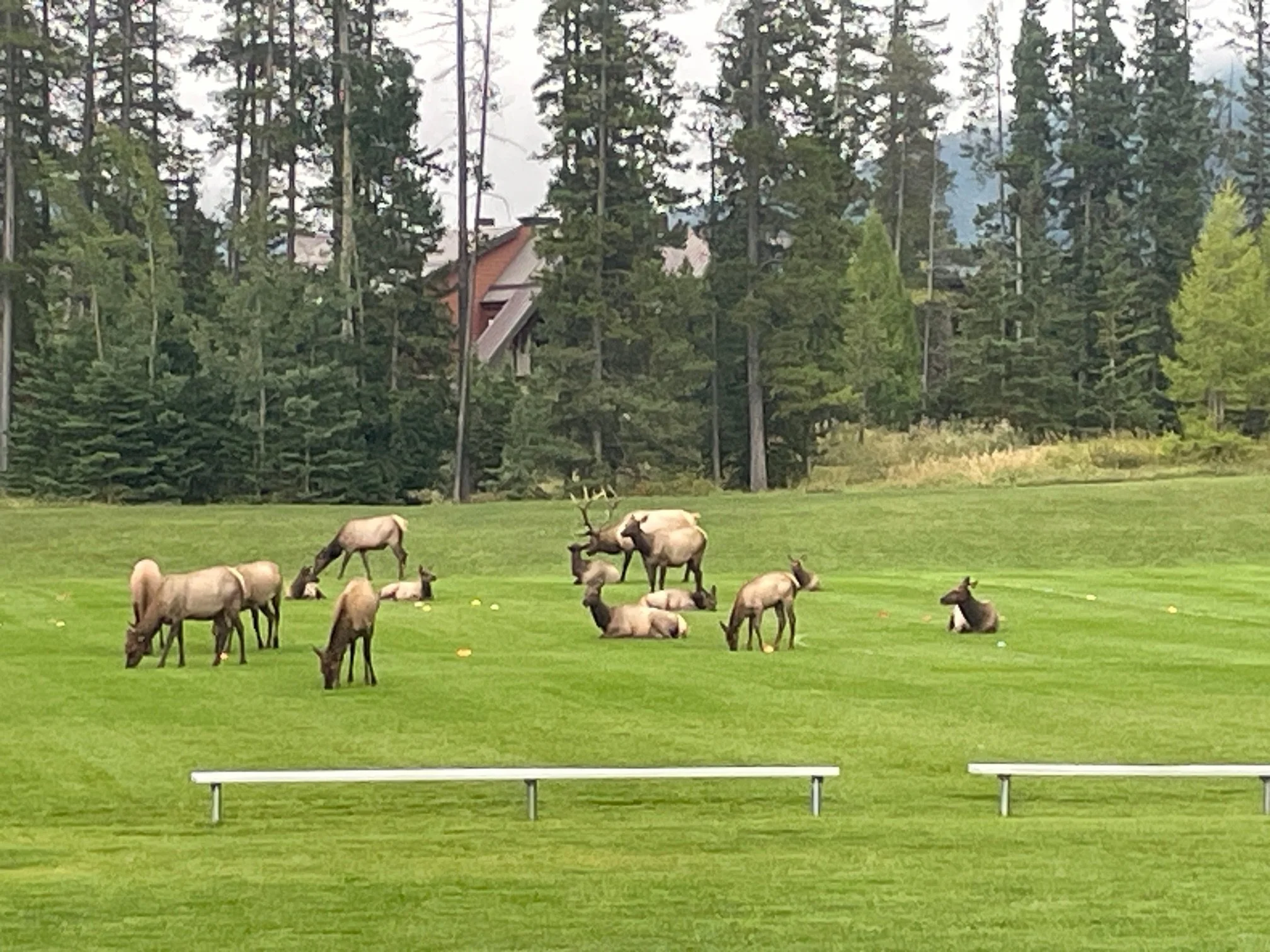
Elk are often found on busy trails, sports fields, parks and playground areas in Canmore. Give them space and NEVER try to sneak past them!
Hunters need to be cautious as, due to the nature of their activity, they are intentionally being quiet on the landscape. They should always be bear aware and carry bear spray with them while out hunting! Bear spray can save the life of the hunter AND the bear(s).
VIEW CURRENT WARNINGS AND CLOSURES
Please report any sightings of a bear, cougar, wolf or any aggressive wildlife in the Bow Valley or K-Country to Kananaskis Dispatch at 403-591-7755. In Banff, call Dispatch at 403.762.1470. They prefer to get the reports first hand from the people who see the wildlife!
SOME THINGS TO ‘BEAR’ IN MIND
To follow up on last week’s discussion about off-leash dogs, we wanted to provide you with some more dog related resources.
From Aug.18, 2022 - Here is the link to the recording of the "Impact of off-leash dogs on wildlife" webinar recording by the Alberta Chapter of The Wildlife Society (ACTWS). They explore some of the science behind dogs off-leash - impacts and owners' compliance with regulations. Here are the speakers’ abstracts and bios.
In case you missed this from this past August, new research published in the Journal of Wildlife Management finds off-leash dogs often escalate bear encounters. In a peer-reviewed study titled The Canine Conundrum: Is a dog a help or hindrance in bear country?, researchers analyzed 326 documented human–bear conflicts that involved domestic dogs (i.e., not dogs trained to aversively condition or haze bears) and bears across North America between 1901 and 2023. The data shows people are largely unprepared for bear encounters and naive to their possible consequences. Dogs ran away, fought with bears, provoked confrontations, drew owners in to fight off bears barehanded, and even boomeranged bears back to people. The data also showed how few people carried any deterrent at all, and that might be because people thought, erroneously, that dogs would be sufficient to keep bears away. Some other key findings from this study:
Women are nearly twice as likely as men to physically engage with a bear to defend their dog.
In 54% of the analyzed conflicts, the dog clearly provoked the bear. The encounters left 166 people injured and five dead. Bears also killed 56 dogs, including 44 that were off-leash, underscoring the heightened risk when dogs are allowed to roam freely. There were also more than 10 times as many dog deaths as human deaths. No human fatalities occurred when dogs were leashed.
Unleashed dogs dramatically increase the risk of dangerous encounters with bears. Off-leash dogs were involved in six times as many incidents as leashed dogs.
The larger the group of people, the less likely a human–bear–dog incident will occur; however, the presence of a dog more than doubled the odds of a bear conflict when compared to the same-sized groups without dogs.
In 70% of cases where an off-leash dog brought a pursuing bear back to their owners, the owner was injured.
Dogs provided an early warning to their owners of the presence of a bear in only 9.2% of cases, which was roughly 1 in 11 times. During an active bear attack, 36% of dogs failed to come to their owner’s aid, undermining the hope that a dog may divert the bear's attention from people and defend them from it.
Carrying a bear deterrent (such as bear spray) decreases the odds of injury and increases one's safety in bear country.
So are dogs a help or hindrance in bear country? “Dogs can sometimes help alert people to bears, but overall, they more often contributed to conflict than prevented it,” said scientist Lana Ciarniello, one of the study’s authors who is also co-chair of the IUCN’s Species Survival Commission’s human-bear conflicts expert team. “They occasionally warned their owners or they occasionally did distract bears, but more frequently, they initiated the encounters. More than that, many of the owners were injured while trying to save their dogs. We found that the safest approach in bear country, if you have your dog, is to keep your dog leashed, to hike in a group and to carry an effective bear deterrent such as bear spray, and consider leaving dogs behind in areas with frequent bear encounters.”
RELATED ARTICLES:
New research finds off-leash dogs often escalate bear encounters.
Off-leash dogs increase chance of human-bear conflict: study.
New study examines whether dogs help or hinder people in Bear Country.
Final thought: Be a good neighbour and pick up after your dogs as their feces can act as an attractant for wildlife. As a pet owner it is YOUR responsibility to pick up and dispose of your pet’s waste properly. Doggy poop bags need to be put in wildlife-proof bins, not left on or alongside the trails! Here is a great short video about the Invasive Doggy Poop Bag…
WILDLIFE AMBASSADOR WORDS OF WISDOM
"BUSTING BEAR MYTHS" BY DEREK RYDER, WILDLIFE AMBASSADOR
Myth: By having my dog with me on a trail, I’m less likely to risk a bear attack.
Fact: Bears don’t like dogs. In truth, they don’t understand what a “dog” is. But they do understand canids, which is the family of animals dogs are in. Canids here are wolves, coyotes and foxes. Bears don’t like any of them. Wolves try to steal bear kills, and will predate young bears. Coyotes and foxes try to scavenge from bear kills. Bears don’t see canids as a good thing. They see wolves, dogs, and coyotes as threats.
If your dog lunges and barks at a bear, even on leash, that’s seen by the bear as aggression. Bears are big enough to believe – rightly so – that they’re the kings of the forest. If a canid is aggressive towards them, they’ll probably be aggressive back – which will be bad for your dog, and bad for you. Sure, it might scare the bear off, especially if there are a few of you and you look like a pack to a bear (bears don’t like packs of anything). If your dog turns and runs, that will trigger a pursuit reflex in a bear. Prey runs away. By running, your dog just identified itself as something worth chasing.
Dogs rarely make bear encounters better. Even on-leash, your dog is generally not going to be an asset in a bear encounter. It may actually turn an otherwise benign encounter into an attack situation. Plus, bear spray is a two-handed thing. How do you use two hands when one of them has a leash in it, attached to a dog?

Bears see wolves (pictured), dogs, and coyotes as threats. Photo credit: Yellowstone National Park Flickr.
FOOD FOR THOUGHT?
Bears are so focused on food this time of year that they are more likely to take risks, like coming into town and backyards to feed in fruit trees and eating pumpkins. Letting a bear access these higher calorie items won't do it any favours. Once they try these food sources they can learn that towns provide easy meals, meaning they're more likely to stick around and come back. This can become a public safety issue as bears can get protective of food sources, leading to conflicts between bears and humans, with bears normally paying the price by getting relocated or killed. Ever wonder how many calories are in the ‘unnatural’ foods provided by people vs. the ‘natural’ foods provided by nature? It’s no wonder bears are willing to take the risk to access these higher calorie ‘unnatural’ foods.

Image from the Living With Bears Handbook. Copyright 2015 Linda Masterson.
Remove all fruit from branches and dispose of it responsibly. Picked fruit can be put in the residential food waste bins around town. Leaves, branches and clippings can be disposed of separately in the appropriate bins at the 115 Boulder Crescent Recycling Depot.
Need help removing the fruit? WildSmart has pruning shears, extendable pole saw pruners and fruit pickers that can be borrowed (free of charge) to assist Bow Valley residents in removing that hard to reach fruit. Please send an email to resource@biosphereinstitute.org to make arrangements to borrow the fruit removal equipment.
Get FREE money and apply for the Town of Canmore’s Fruit Tree Removal and Replacement Incentive NOW: Picking fruit every year is a lot of work so the recommended long-term solution is to remove your fruit tree! There is still plenty of money remaining in the budget this year for the Town of Canmore’s Fruit Tree Removal and Replacement Incentive Program so we urge you to consider removing your fruit tree now while the funds are available! Click here for more details!

Pumpkins are a wildlife attractant to all sorts of animals, not just bears. You can help keep bears and other wildlife out of trouble by keeping your pumpkins indoors! Photo courtesy of Parks Canada.
Halloween is just over a week away and there are pumpkins outside on doorsteps. Please be proactive to help keep your children, the children in your neighbourhood and our local wildlife safe by placing pumpkins inside of windows and NOT outside on your doorstep. Pumpkins are a wildlife attractant to all sorts of animals, not just bears, and we all need to do our best to avoid attracting wildlife into residential areas. You might think that your pumpkin is safe on a balcony, far off the ground, but bears are very good climbers. Check out this video of an ingenious bear climbing up onto a balcony. Pumpkins can be put outside on Oct.31 to be enjoyed by trick-or-treaters but make sure you bring them back inside before going to bed!
After Halloween, please dispose of your pumpkins properly and do not leave them outside inviting them to get smashed up by pranksters or eaten by wildlife. In Canmore, pumpkins should be disposed of in the bear-proof Residential Food Waste Containers and remember to remove candles and other non organic decorations! RELATED ARTICLE: Don’t leave your pumpkins out. Squirrels aren’t the only ones who want to munch on them.
WILDLIFE IN THE NEWS
Stephen Herrero wrote the book on bear attacks — his legacy doesn’t end there.
Banff National Park superintendent faces no charges for off-leash dog.
Fat Bear Week 2026 is over, but could the Bow Valley have its own?
Disqualified giant pumpkin wins over polar bear in Cochrane, Ontario.
Man uses hockey net to drive off bear in Canada.
Trump moves to reopen Alaska national preserves to bear baiting by sport hunters.
I Hunted Japan’s Deadly Brown Bears, and Met the Greatest Bear Hunters in History.
CURRENT OPPORTUNITIES
Join our Board of Directors!
We seek new board members with a passion for our community and our environment. We are particularly interested in candidates who have experience in any of the following areas:
non-profit governance and management
financial management
fund development in the non-profit sector (philanthropy)
serving in executive positions on boards
Please click here for more information and how to apply. Deadline for applications is Oct.30.

AND NOW SOME PAWS-ITIVE NEWS
Is your refundable recycling piling up? Did you know you can help support us by donating your refundable recyclables through SkipTheDepot? It's so convenient to have your refundable recyclables picked up at your door, with proceeds going to Biosphere Institute. Collections can now be scheduled in Canmore and many other towns and cities. Recycling is now as easy as 1,2,3:
1. Download the app or register online, and book a pickup by clicking on this link.
2. Place your bags outside
3. Your refund gets donated directly to the Biosphere Institute!
Spread the word and share with friends! SkipTheDepot is a great way to donate directly to the Biosphere Institute of the Bow Valley and WildSmart. Thanks for your support!

UPCOMING EVENTS
Oct.24 - Annual Recycling Roundup (10am-4pm). Banff residents only, can stop by the Beaver Street parking lot next to the Fire Hall to drop off items including bear spray, paint cans, spray paint cans, propane tanks, household hazardous waste, oil filters, used oil and empty oil containers, electronics, tires, and household batteries for free collection and disposal or recycling. Visit banff.ca/Roundup to view the list of accepted items.
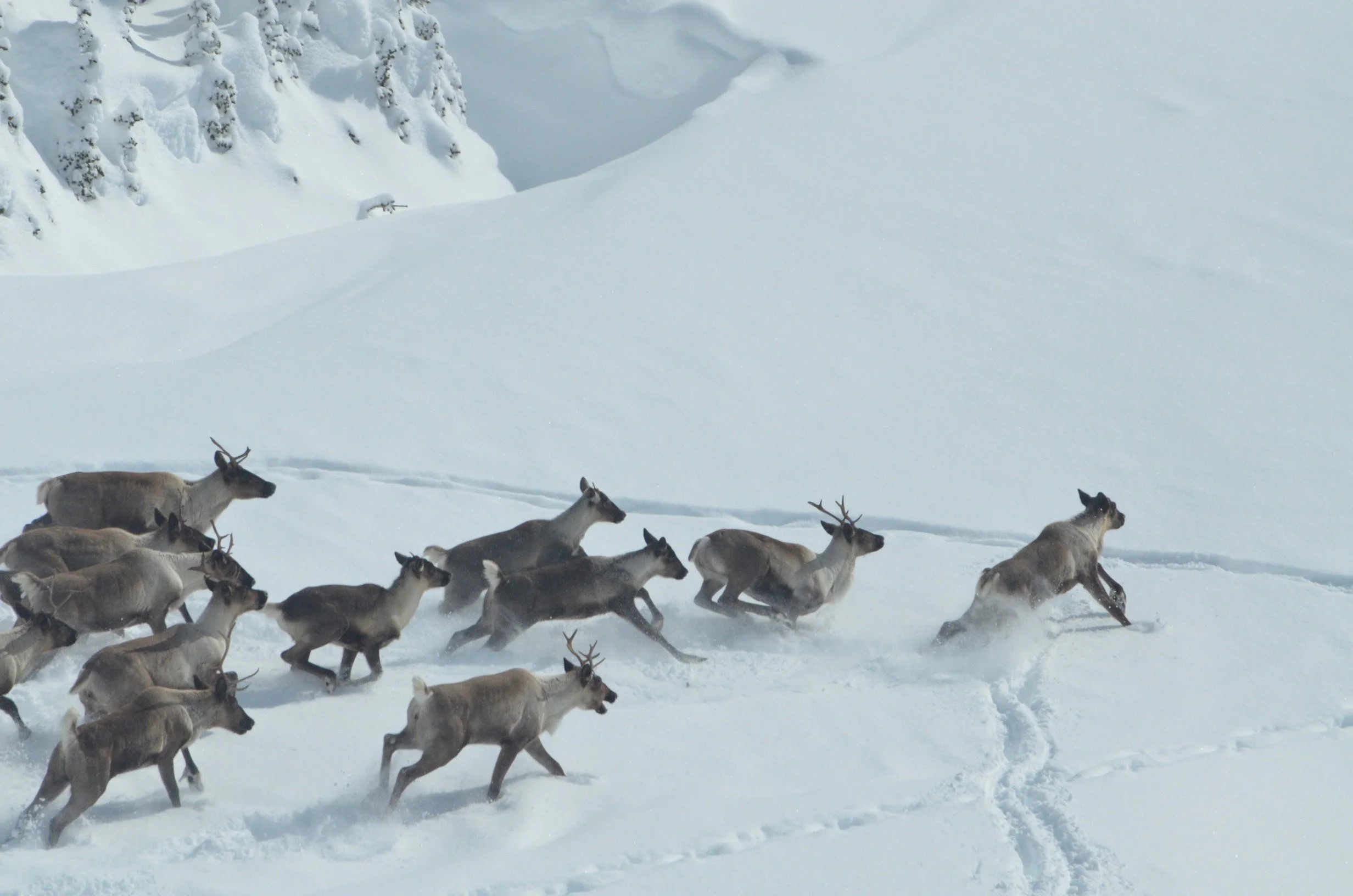
Oct.27 - The Bow Valley Naturalists have their first talk of the season: The Science and Human Values of Caribou Recovery in Western Canada with Dr. Robert Serrouya. Rob Serrouya, whose research focuses on testing recovery options for caribou and other species through broad-scale adaptive management experiments, will deliver the presentation on Tues. Oct.27 at 7:30pm at the Catharine Robb-Whyte building at 101 Bear Street in Banff. Free, everyone is welcome to attend - in person and online! (Online viewers please register in advance here. You will receive a confirmation email containing the link to join the meeting.)
Nov.13, 2026 - Do-Si-Do with the Biosphere at our 4th Annual Square Dance Community Fundraiser! Join us for a boot-stompin’ night of live music, square dancing, good company, light snacks, a silent auction, and plenty of laughs. No square dance experience needed—our fantastic caller will teach you every step!
When: Friday, November 13, 2026
Where: Canmore Creekside Hall (New Location!!!)
Tickets: Click here to buy your ticket now!
Silent auction, cash bar, dancing, 50/50 and light snacks! All proceeds support the Biosphere Institute and our work advancing climate action and human-wildlife coexistence throughout the Bow Valley. Bring your friends, bring your boots, and come dance for a good cause.

Nov.23 - Earth Talks | Beyond Fuel Reduction: Community Science and the Future of Fireguards for People and Wildlife. How do mountain meadows support wildlife in the Bow Valley? Join local ecologist Jonathan Farr for November’s Earth Talk to discover how species like bison, elk, and bighorn sheep rely on mountain meadows for crucial forage throughout the seasons. Explore how wildfire risk reduction efforts could help restore these important habitats, and how community science and stewardship can support healthier landscapes for wildlife. Mon. Nov.23 | 7–8pm at Canmore Public Library (Friends Program Room). Free or by donation and registration is required. Register today to save your spot!
Nov.25-27 - 2026 Building for Sustainability Symposium! Join us in Canmore for three days of learning, connection, and practical conversations about the future of the built environment. This year’s Symposium explores the themes of Innovation | Collaboration | Small Changes, Big Impacts, bringing together builders, developers, architects, engineers, municipal leaders, sustainability professionals, and others working to create more resilient, efficient, and sustainable communities. The program will feature engaging workshops and panel discussions, technical demonstrations, inspiring speakers, networking opportunities, and field trips showcasing real-world projects throughout the Bow Valley. Register to save your spot NOW!

Please remember BEARS CAN BE ENCOUNTERED ANYWHERE, ANYTIME!
Report any sightings of a bear, cougar, wolf or any aggressive wildlife in Kananaskis Country or the Bow Valley to Kananaskis Dispatch at 403.591.7755