
The Canmore Area Trails Master Plan has the potential to make this valley better for trail users – AND for wildlife! But we’re not there yet…
Thanks to everyone who attended our Panel Discussion and Information session on Jan.14! The evening was a big success with over 200 people in attendance, plus another 36 via Zoom. We have had several requests to share the presenter’s slides from the session so here they are at the following link:
Our Call to Action re: Canmore Area Trails Master Plan

Photo credit: John E. Marriott
We’ve come to understand that unmanaged human recreation on trails is as harmful as development when it comes to how wildlife use – or don’t use – this valley. Over two thirds of trails in the Bow Valley are ‘undesignated’ or unsanctioned, with more of these ‘pirate trails’ being built every year. The Canmore Area Trails Master Plan (CATMP) is our best hope to turn this around, creating a superior trail network while protecting valuable ecosystems and an important and internationally-renowned wildlife corridor.
We have achieved much in Canmore that is worth celebrating: four decades of work to protect wildlife corridors, and bear-proof garbage containers so no more bears die because they’re in our garbage! Next up: a better plan for trails.
So - here’s our call to action. Before the Government’s 21 January 2026 deadline:
Read the Canmore Area Trails Master Plan. The good news is that if you wish to comment on this as a whole - you only have to read 12 pages! (pp 3-15).
Fill out the government’s survey, following our survey response suggestions.
Add your comments to the interactive map of your favorite trails. These comments are an important input for the government.
Write to the Minister. The Honourable Todd Loewen is Minister of Forestry and Parks – the Minister enjoys hearing from everyday Albertans. Email him, call his office, or write a letter – and feel free to borrow from the bolded text below, in the next section - OR from our own letter to the Minister, which you can read here. He’s at FP.Minister@gov.ab.ca, or (780) 644-7353. Don’t forget to cc our local MLA (Banff.Kananaskis@assembly.ab.ca) and the NDP’s shadow Minister for Forestry and Parks, Jodi Calahoo Stonehouse (Edmonton.Rutherford@assembly.ab.ca).
Read through the presentation slides from our Information session on Wed. Jan.14, 2026.
Please scroll down to read our comments about the Master Plan and the scientific basis for our work.
How we feel about the Canmore Area Trails Master Plan
We believe that, properly done, the draft Canmore Area Trails Master Plan is our best chance to improve future prospects for wildlife, and support the local economy - but we’re not there yet.

Photo credit: Government of Alberta
It is absolutely critical that we get this Plan right - otherwise we risk cutting off the last remaining wildlife corridor connecting Banff National Park and Kananaskis Country. Science tells us we've already LOST 85% of the wildlife connectivity we used to have in this area - WE ARE AT A TIPPING POINT.
Any successful trails master plan must contain three E’s: Engineering, Education, and Enforcement. Although the Engineering component is good, Education and Enforcement is missing from this document.
Specifically: the Plan’s trail design principles contain many pro-environment features, including trail-free areas, seasonal closures, trail bundling, community loops, and decommissioning 275 km of unauthorized trails - while at the same time designating 537 km of trails, including 232 km of new designated trails, some in higher elevation terrain that is less valuable for most wildlife.
(Use the following points in your note to the Minister): The Plan creates the potential for a better trail system and user experience, AND better outcomes for wildlife, including habitat improvement and less restricted wildlife movement – but ONLY if the Plan is improved by including key management features:
Informing and educating trail users about how to avoid conflicts between users (e.g. hikers and mountain bikers), helping them know where they are so they don’t get lost, how to stay safe in wildlife habitat, and to stay on authorized trails to respect the wildlife that use wildlife corridors.
How enforcement will be implemented.
Monitoring of human and wildlife use of the area - and how findings will be used to adapt how the area is managed.
How the trail system will be governed in the long term: how responsibility and authority will be shared between the province, municipalities, and landowners.
Unless this important content is added and then implemented, human use of the proposed trail network will not be well managed – and the Plan will fail.
The Final Terms of Reference for this initiative (basically, what should be in the master plan) details what the scope of the Master Plan should be (pp. 8-10) yet the master plan itself contains only a fraction of that information. The government should have followed its very own terms of reference. Both these documents can be found on the government's landing page for this entire initiative.
We believe that trail users want to do the right thing – but as it stands now, trail users won't know if they're on an unauthorized trail or an official (sanctioned) trail, won't know if they're in or close to a wildlife corridor, and won't learn some common sense guidelines (dogs on leash, making noise on the trail, etc) that keeps them and wildlife safe.
We support the Plan’s Desired Conditions (pages 6-7), that describe desired ecological conditions, visitor experience, and trail governance (including adaptive management and monitoring) - but the plan contains nothing that shows how these desired conditions will be met.
Despite the name, this initiative covers a large and ecologically important area, from Banff’s east park gate to Seebe (map).

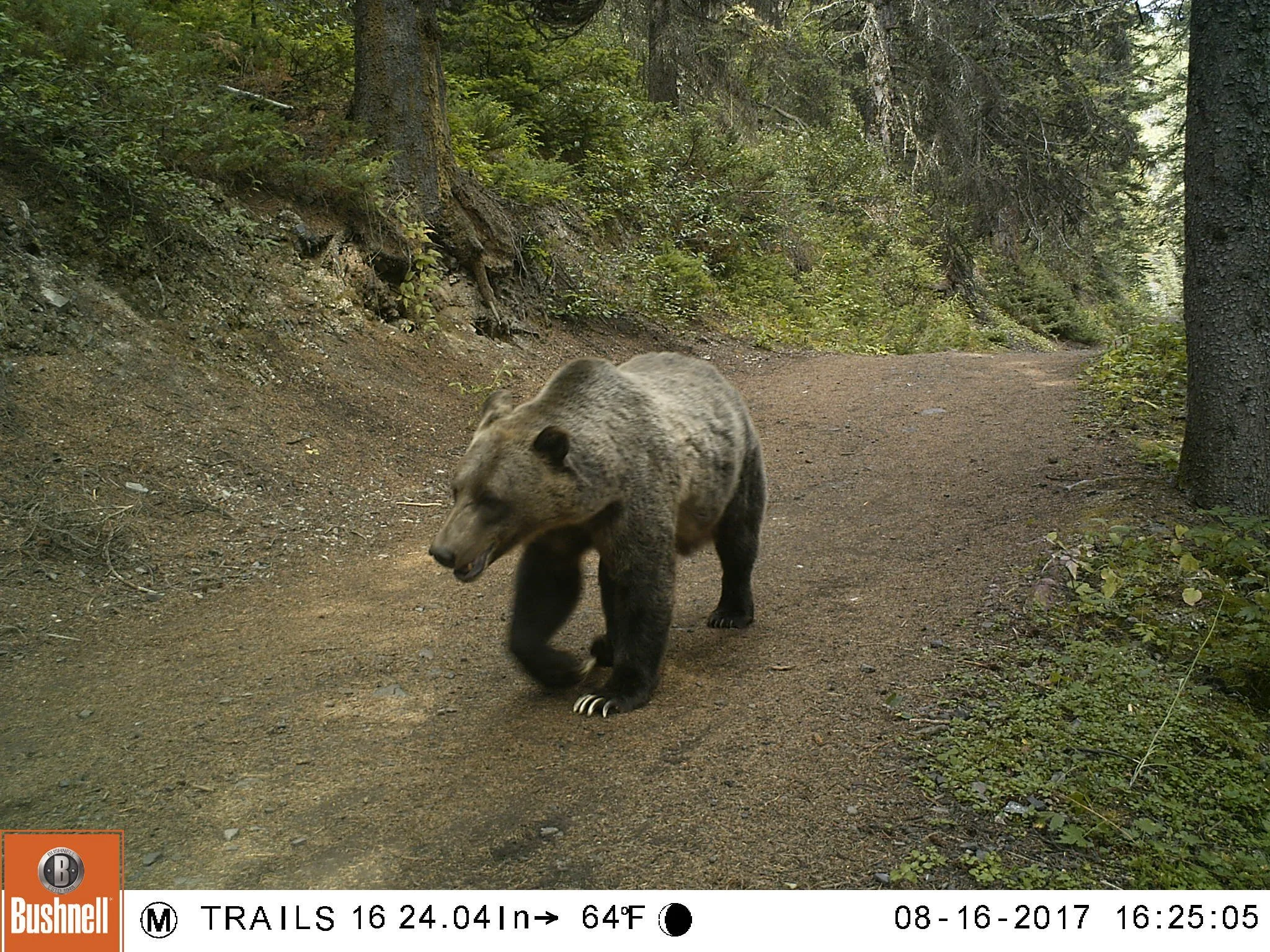
Note the timestamp on each image. Photo credit: Government of Alberta
The scientific basis for our work
Science shows us that how, where, and when we recreate directly affects whether bears, wolves, and other animals can safely move through the valley. The good news? We already know how to meet the needs of wildlife while still providing great outdoor experiences for people. Small changes in how we design and use trails can make a big difference.
Current human development has reduced wildlife connectivity by 85%, relative to historical times. Peer-reviewed paper: ‘Towns and trails drive carnivore movement behaviour, resource selection, and connectivity’. Ref: Whittington, J., Hebblewhite, M., Baron, R.W. et al. Mov Ecol 10, 17 (2022).
The Y2Y’s 2021 cumulative environmental assessment of the Bow Valley showed that both recreation and human development put wildlife at risk: Grizzly bear movement and conflict risk in the Bow Valley
Cathy Ellis' March 2021 RMO article on the study here: ‘New study shows wildlife struggle to navigate busy Bow Valley’
Thompson P et al. 2025. “Integrating human trail use in montane landscapes reveals larger zones of influence for wary carnivores”. Journal of Applied Ecology 62: 344-359
Synopsis: grizzly bears and wolves are less likely to be found both on and nearby trails that have a lot of human use. Specifically, these effects are strong within 300 m for grizzlies and 600 m for wolves, with weaker effects extending out to nearly 2 km for grizzlies and 5 km for wolves. Our results suggest that all the trail activity in the Bow Valley has led to significantly fewer bears and wolves in that area.
“Temporal road closures improve habitat quality for wildlife.” Our strong and consistent results suggest temporal closures are an important conservation tool that can increase habitat quality for wildlife while minimizing effects on people.
Related Media
Jessica Lee’s RMO article about the CAMPT (Dec.5, 2025): 'Plan proposes major overhaul of Canmore area trails’
Jessica Lee’s RMO article about CAMBA’s event (Dec.18, 2025): ‘Balancing bikes, hikes and bears: Canmore trails plan a ‘long time coming’’
CBC’s article (Jan.1 2026): ‘Pirate trails are abundant in Canmore, but the province wants to shut many of them down’
Jessica Lee’s RMO article (Jan.20, 2026): ‘Last chance landscape’: Canmore trails plan will be tested by human use’
Our Relevant Videos
Thanks to Tracey Henderson and Gareth Thomson for their thoughts on how this plan holds real promise of offering a better deal for both trail users and wildlife if it’s implemented properly. That means not just trail design, but the human management pieces that belong in any strong master plan: education, enforcement, and proper management.
This Trails Master Plan has real potential, if it’s paired with education & enforcement. Thanks to Laura Quelch and Canmore & Area Mountain Bike Association for championing a future where people and wildlife all belong.