
Did you know that WildSmart is a program of the Biosphere Institute, a local charity? Our work relies entirely on donations and sponsors. If you would like to support our community-based efforts to promote human-wildlife coexistence, please DONATE NOW!
Bow Valley trails – Help make them work for people AND wildlife!
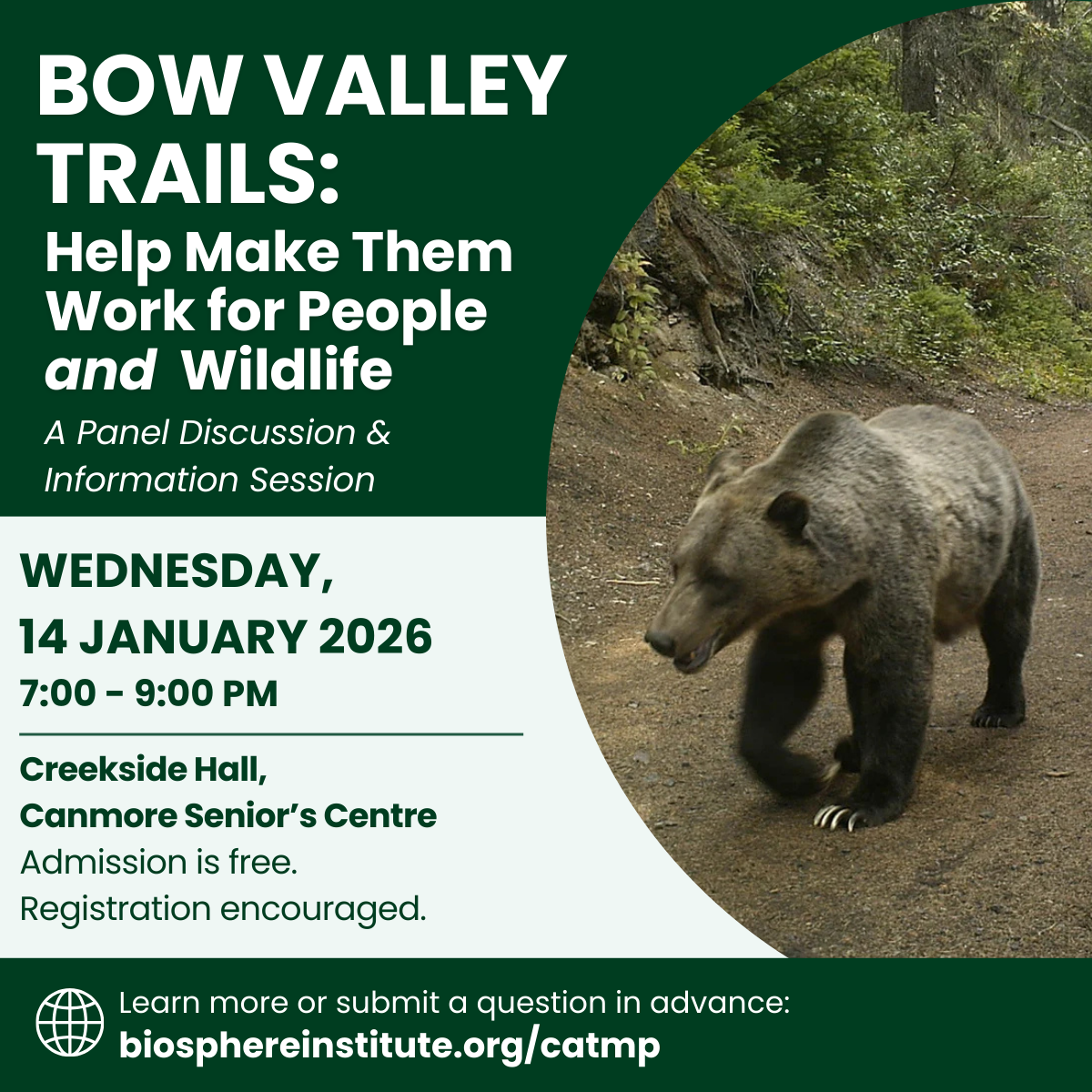
A panel discussion and information session
Wednesday 14 January, 7 to 9 PM
Creekside Hall, Canmore Senior’s Centre
The Canmore Area Trails Master Plan has the potential to make this valley better for trail users – AND for wildlife! But we’re not there yet…
You’ll have a chance to review and discuss the trail maps proposed for your favourite places in the Bow Valley, hear about the Master Plan, and learn what you can do to help ensure that the Plan works for both people AND wildlife. Our panelists include…
Peggy Holroyd, Planner, Alberta Forestry and Parks
Bill Hunt, Senior Conservation Lead, Yellowstone to Yukon
Dr. Tony Clevenger, Bow Valley Naturalists
Laura Quelch, E.D., Canmore & Area Mountain Bike Association
Gareth Thomson, E.D., Biosphere Institute of the Bow Valley
Admission is free (but donations will be gratefully accepted) - and we ask that you preregister by clicking here, which also allows you to send us your questions about the plan ahead of time!
That same webpage will help you learn more about our concerns, and see our suggestions on how to respond to the government’s request for input before the 21 January deadline.
This Trails Master Plan has real potential, if it’s paired with education & enforcement. Thanks to Laura Quelch and Canmore & Area Mountain Bike Association for championing a future where people and wildlife all belong.
The Canmore Area Trails Master Plan
The Bow Valley is one of the most ecologically important wildlife corridors in North America, connecting Banff National Park and Kananaskis Country. But today, wildlife movement here is under serious threat.
What many people don’t realize is that unmanaged recreation on trails can be just as harmful to wildlife as development, when it comes to how wildlife use – or don’t use – this valley. Over two-thirds of trails in the Bow Valley are currently undesignated or unauthorized, and more “pirate trails” are being created every year.
The Canmore Area Trails Master Plan (CATMP) is our best opportunity to change this trajectory by creating a better, safer, and more sustainable trail network while protecting the ecosystems and wildlife that make this place so special. But the Plan needs improvement, and public input is critical. We believe this CATMP is a win for trail users, but we need to also make sure it is a win for wildife!
Why This Matters

Canmore has a strong legacy of conservation. Decades of community action helped protect wildlife corridors and introduce bear-proof garbage systems which dramatically reduced wildlife conflict.
Trails are the next big challenge...
Science shows we have already lost 85% of historical wildlife connectivity (Whittington et al., 2022) in this area. We are at a tipping point. If this Plan is not done right, we risk severing one of the last remaining corridors for wildlife movement in the Bow Valley.
Our Position on the Draft Plan
We believe that, if properly improved, the draft Canmore Area Trails Master Plan represents our best chance to support both:
Healthy wildlife populations, and
A high-quality recreation experience that supports the local economy
The Plan includes many positive design elements:
Trail-free areas and seasonal closures
Trail bundling and community loops
Decommissioning ~275 km of unauthorized trails
Designating 537 km of trails, including new trails in higher-elevation areas that are less valuable for most wildlife
However, good trail design alone is not enough. Any successful trails master plan must include three E’s: Engineering, Education, and Enforcement.
While the Engineering component is strong, the draft Plan is missing:
How trail users will be informed and educated about wildlife, safety, and sensitive habitats
How enforcement will work on the ground
How monitoring of wildlife and human use will occur and how management will adapt
How the trail system will be governed long-term
Without these elements, human use will remain unmanaged and the Plan will fail to meet its own goals.
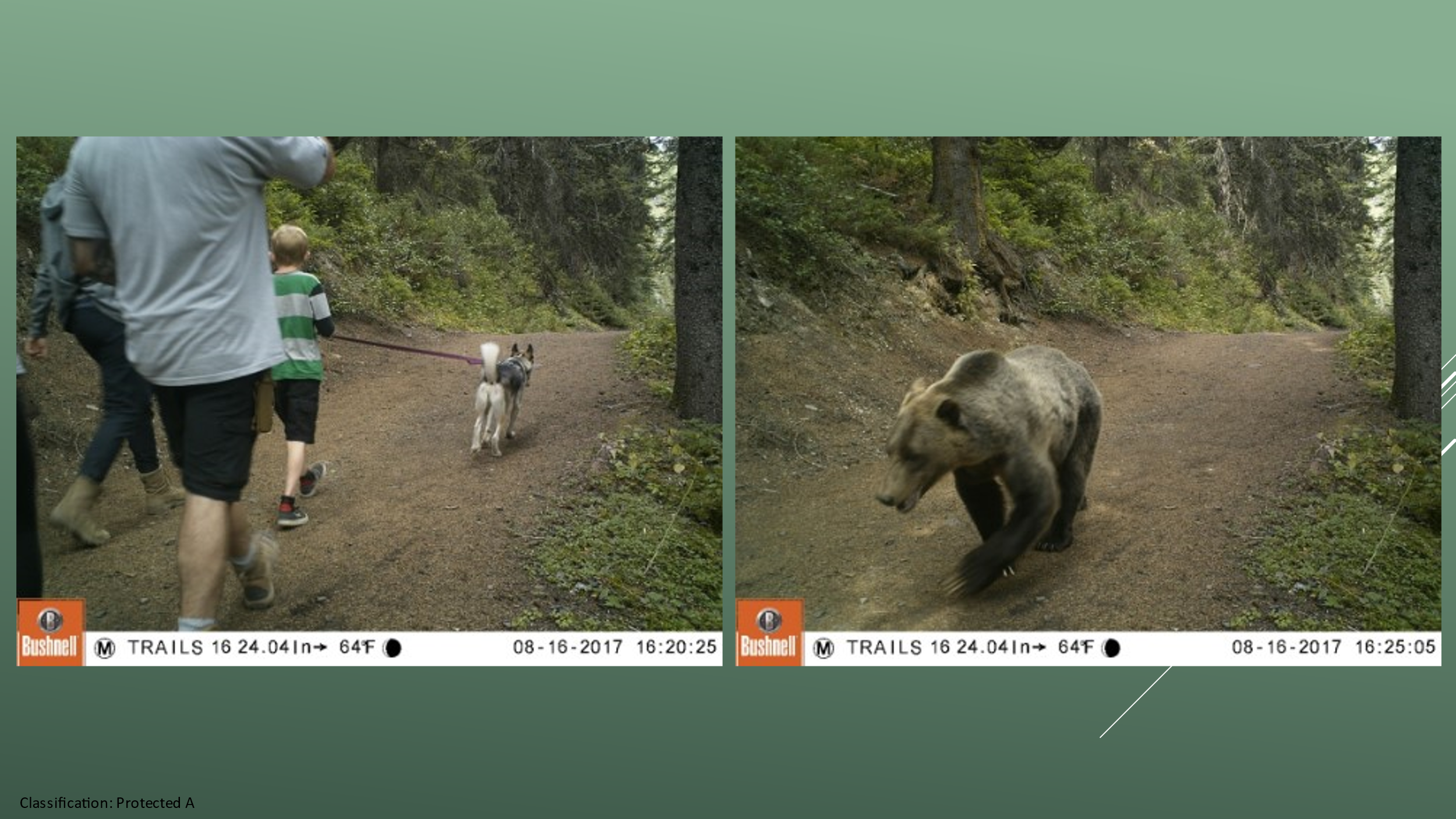
**Note the timestamp on each image, less than 5 minutes apart. Photo courtesy of the Government of Alberta.
Our Call to Action
You don’t need to be a scientist or planner to make a difference. Here’s how you can help before the January 21, 2026 deadline:
Read the draft Master Plan
The good news: to comment on the overall direction, you only need to read 12 pages (pages 3–15).Attend Our Upcoming Information Session
📅 Wednesday, January 14, 2026
🕖 7:00–9:00 pm
📍 Canmore Seniors’ Centre, Creekside HallComplete the Government Survey
We’ve created survey response suggestions to help you provide effective, informed feedback.Add Comments to the Interactive Map
Sharing your knowledge of favourite trails and areas of concern is a critical input for the government. We’ve also created a step-by-step map engagement guide.Write to the Minister
Consider writing to the Honourable Todd Loewen, Minister of Forestry and Parks. Email him, call his office, or write a letter – and feel free to borrow from the bolded text on our website. He’s at FP.Minister@gov.ab.ca, or (780) 644-7353. Don’t forget to cc our local MLA (Banff.Kananaskis@assembly.ab.ca) and the NDP’s shadow Minister for Forestry and Parks, Jodi Calahoo Stonehouse (Edmonton.Rutherford@assembly.ab.ca).Vist our website to read our comments about the Master Plan and the scientific basis for our work.
A few minutes of your time could make a huge difference for the future of wildlife in the Bow Valley!
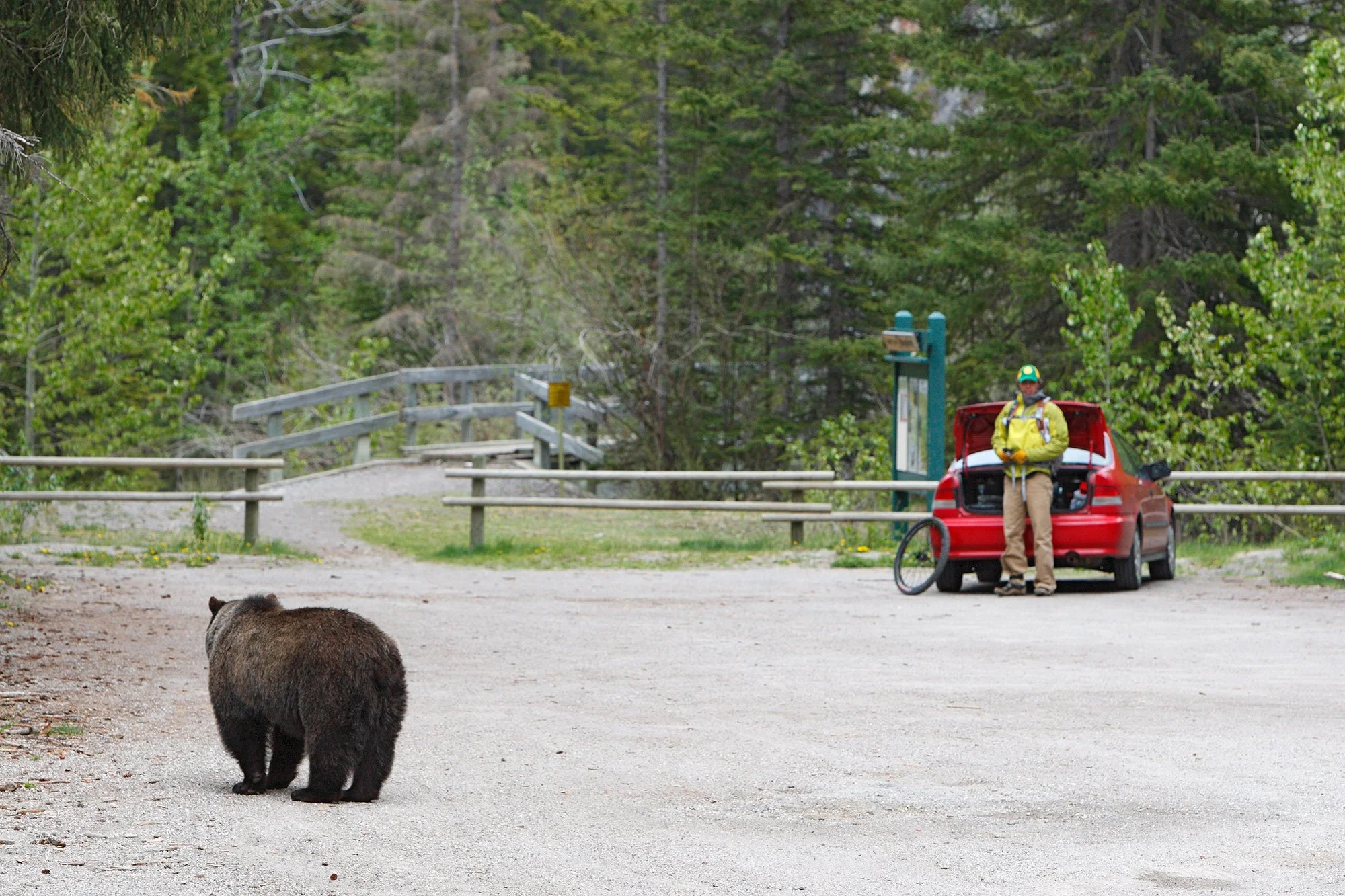
Photo by John E. Marriott.
The Science Is Clear
Peer-reviewed research (Thompson et al., 2024) consistently shows that human trail use significantly reduces wildlife presence and movement, especially for sensitive species like grizzly bears and wolves.
Key findings include:
Grizzlies avoid areas within 300 m of high-use trails (with impacts extending up to 2 km)
Wolves avoid areas within 600 m of trails (with impacts extending up to 5 km)
Both recreation and development are major drivers of habitat fragmentation in the Bow Valley
Seasonal and temporal closures are proven tools to improve habitat quality while minimizing impacts on people
This is not about stopping recreation. It’s about managing it responsibly so people and wildlife can coexist.

Learn More
Visit our website to learn more about Our Call to Action. You’ll find background information, our detailed comments on the Plan, survey and interactive map guides, and scientific research behind our recommendations. Together, we can help shape a trail system that works for people, for wildlife, and for future generations.
WILDLIFE CAN BE ENCOUNTERED ANYWHERE, ANYTIME!
Please report any sightings of a bear, cougar, wolf or any aggressive wildlife in the Bow Valley or K-Country to Kananaskis Dispatch at 403-591-7755. In Banff, call Dispatch at 403.762.1470. They prefer to get the reports first hand from the people who see the wildlife!