

Did you know that WildSmart is a program of the Biosphere Institute, a local charity? Our work relies entirely on donations and sponsors. If you would like to support our community-based efforts to promote human-wildlife coexistence, please donate now!
BEAR ACTIVITY UPDATE (August 14, 2026)
(Banff National Park East Gate to Bow Valley Provincial Park)
Bear activity has increased a lot this past week with bears in search of the berries that are out in the Bow Valley. Berry abundance is not great this summer and this is making bears move around the landscape in search of this food source. This includes sows with cubs (family groups of bears) and both new and experienced mother bears will be very defensive of their cubs when surprised by people at close range. Although the buffaloberry season in the Bow Valley is starting to wind down, the dogwood berries are abundant in Canmore, and we can expect to see more bears in the Canmore area in the coming days and weeks. As such, residents should be removing berry bushes and any fruit from the trees in their yards to help keep bears out of town and out of trouble!
RELATED ARTICLE: Banff’s legendary grizzly ‘The Boss’ feasts on berries in new photos.
As bears search for berries they are going through day use areas and campgrounds and it is key for them not to get into any unnatural food sources while in these locations. People need to be prepared to encounter bears if they are in areas that have buffalo and dogwood berries and bikers and trail runners need to be making lots of noise - as surprise encounters with bears feeding on berries are happening in the Bow Valley and Kananaskis Country. For example, there is a Bear Warning on the popular Horseshoe Loop Trail in Canmore after two bikers had a surprise close encounter with a black bear sow and cubs that resulted in a bluff charge with bear spray being deployed.
RELATED ARTICLE: Protective mama bear charges mountain bikers in Canmore.
Bears have their heads down and are focused on eating berries, which increases the chance of surprise encounters. Always be prepared and on the lookout for bears feeding on buffaloberries while you recreate, as many berry bushes are found along popular trails. Some key things to remember include:
Expect to encounter bears!
Trail users should be making lots of noise to alert any bears in the area of their presence, and do their best to avoid areas where bears have been seen or where active warnings have been put in place to reduce the risk of encounters.
Bears may be more reluctant to move away from their food source.
Be vigilant and look for bear foods and sign (berries and scat).
If you see a bear: stop, speak calmly, and slowly leave the area - give them plenty of space, at least 100m! Do not try to sneak past them and don’t expect bears to move off a food source.
Bears can be very possessive of their berry patches and may exert their dominance. Give them the space they need to forage undisturbed as these next few weeks are the most important time for them to feed and take in these precious calories for their survival.
Bear spray should always be carried in an easily accessible location (not your backpack) and you need to know how to use it! If a bear is feeding along a trail, do not disturb it, and do not try to sneak past it. Wait, turn around, or find another way around giving it lots of space. It is not fair to the bear if you spray it while it is feeding and minding its own business just so you can walk past it. Remember you are in their backyard, not yours, so if they are behaving and doing what they are supposed to, we need to respect that, give them space and leave them alone!
Properly managing and storing wildlife attractants (such as food, drinks and garbage) is of utmost importance as bears continue to be seen in and around campgrounds and day use areas! ALL attractants need to be secured in your vehicle, hard-sided trailer or bear-proof lockers. Never leave food and scented items in tents as bears can easily access them and always dispose of garbage in bear-proof bins. Never leave your food unattended - even for a minute! RELATED ARTICLE: Camper fined $600 after bear snacks on pepperoni and tuna in Banff National Park.
Having a picnic? Whether you are sitting at a picnic table, or along a river or lake - try not to have too much food out on your table, never feed wildlife and do not let bears and other wildlife get any food rewards as a Fed Bear is a Dead Bear! If you are sitting and eating and a bear starts approaching your food and table, yell and shout to try and scare the bear away, do your best to secure your food by moving your food into your hard-sided vehicle/trailer or locker nearby, and use your bear spray to prevent the bear from getting that food reward. It is crucial that you do your best to make sure bears do not get any food rewards as it could result in bears getting relocated or killed. Your safety and the bear’s life might depend on it! We can’t prevent bears from walking through our picnic areas and campsites, but we can certainly do our best not to give them a food reward or reason to linger! RELATED ARTICLE: Black bears keep finding human food in Banff NP.
To trail users - If a bear is feeding along a trail, do not disturb it, and do not try to sneak past it. Wait until it leaves, turn around, or find another way around giving it lots of space. It is not fair to the bear if you spray it while it is feeding and minding its own business just so you can walk past it. Remember you are in their backyard, not yours, so if they are behaving and doing what they are supposed to, we need to respect that, give them space (at least 100m) and leave them alone.
IMPORTANT: You should always expect encounters and never be thinking “this is a popular trail so it won't happen to me.” All trail users should have a heightened awareness, keep dogs on a leash, carry bear spray and make lots of noise to alert bears of their presence. Bears can and will be encountered on busy trails. If a bear is walking down the trail towards you (and if safe to do so), simply try moving off of the trail to let them pass, but always have your bear spray out and ready just in case. If the bear continues past, you were just in the way. If the bear turns to follow you, there is more going on and you should have your bear spray out and be ready to spray the bear.
Mountain bikers and Trail Runners who are moving quickly (and often quietly) need to be making lots of noise (yelling and shouting) on the trails. Bears are feeding on berries very close to trails and bikers/runners are coming up on them quickly with little warning to the bears. In addition to letting wildlife know they are coming down the trail (by making noise), bikers/runners should slow down to avoid surprise encounters with wildlife, especially around blind corners, at the tops of hills, or in areas with thick vegetation and poor sight lines. They should also always be carrying bear spray.
During this busy summer season, there have been many bear jams, which puts unnecessary stress on the animals and causes public safety concerns. Motorists should obey posted speed limits and slow down near roadside wildlife - but don’t stop and cause (or be part of) a bear jam on the highway. Give bears at least 100m of space at all times and do not linger near wildlife feeding roadside - keep moving along and never get out of your vehicle! The Friends of Kananaskis Country have some great Tips for Roadside Wildlife Viewing for motorists and cyclists.
Mother grizzly and cub in K-Country. Photo taken on Aug.16, 2025.
VIEW CURRENT WARNINGS AND CLOSURES
Bear Warning - Mt. Lorette Ponds Day Use Area due to a black bear sow and her cub that have been frequently observed around the ponds, picnic areas, and parking lot. Do not approach or exit your vehicle if the bear is observed nearby.
Bear Warning - Horseshoe Loop Trail due to a close encounter with a black bear and her cubs.
A reminder to please report any sightings of a bear, cougar, wolf or any aggressive wildlife in the Bow Valley or K-Country to Kananaskis Dispatch at 403-591-7755. In Banff, call Dispatch at 403.762.1470. They prefer to get first hand reports from the people who see the wildlife!
SOME THINGS TO ‘BEAR’ IN MIND
Ever wonder what bears do in August? Learn all about it from our friends at BearWise south of the border. “August at a Glance: Bears have many ways to stay cool during hot summer days. By August, most cubs are weaned. Cubs can often survive on their own if they have to. Bears feast on ripening berries and may travel great distances to dependable food sources. Bears decipher complex messages left in the scents of other bears.” Click here to read the article What bears do in August.
Quiet outings linked to more frequent dangerous wildlife encounters - Here is an interesting article that was recently published about which animals are most likely to be involved in aggressive encounters, defined as potentially dangerous situations between humans and animals, during which activities they're most likely to happen, and which activity-animal pairs hold particular risk. Article: Aggressive encounters with large mammals vary by recreational activity type in Canadian national parks. This study is based on Parks Canada data.
They found that recreational activity type and species significantly alter the frequency of aggressive encounters. Results showed that species mattered, but so did the type of activity and animal-activity combinations. Low impact activities, such as hiking and running, were associated with significantly more aggressive encounters regardless of species involved, despite their presumed minimal ecological footprint.
Irrespective of recreational activities between 2010 and 2023, elk were involved in the most aggressive encounters 62%, followed by grizzly bears (14%), black bears (13%), mule deer (7%) and coyotes (3%). Species-recreational activity interaction effects showed aggressive encounters vary significantly depending on specific combinations. Notably, aggressive grizzly bear encounters were more frequent during low impact activities while aggressive mule deer and coyote encounters were less frequent during almost all recreational activities. These findings show that large mammals exhibit species-specific risk perception, with subsequent aggressive behaviour varying by recreational activity type. Their results suggest that national parks should target high-risk recreational activity-species interactions to effectively mitigate aggressive encounters, thereby promoting wildlife health and visitor safety, and supporting biodiversity conservation.
"We found low-impact activities were associated with the highest frequency of aggressive encounters, regardless of species," said first author Holly Landles, a researcher at the University of York.
"Now we can point to precise high-risk pairings, such as elk visiting townsite areas or mule deer encountered during dog walking," added senior author Dr. Shashank Balakrishna, a biologist at the University of York. "This allows park managers to focus resources, signage and education where they are most needed." Here is a figure from the study showing some of the results:
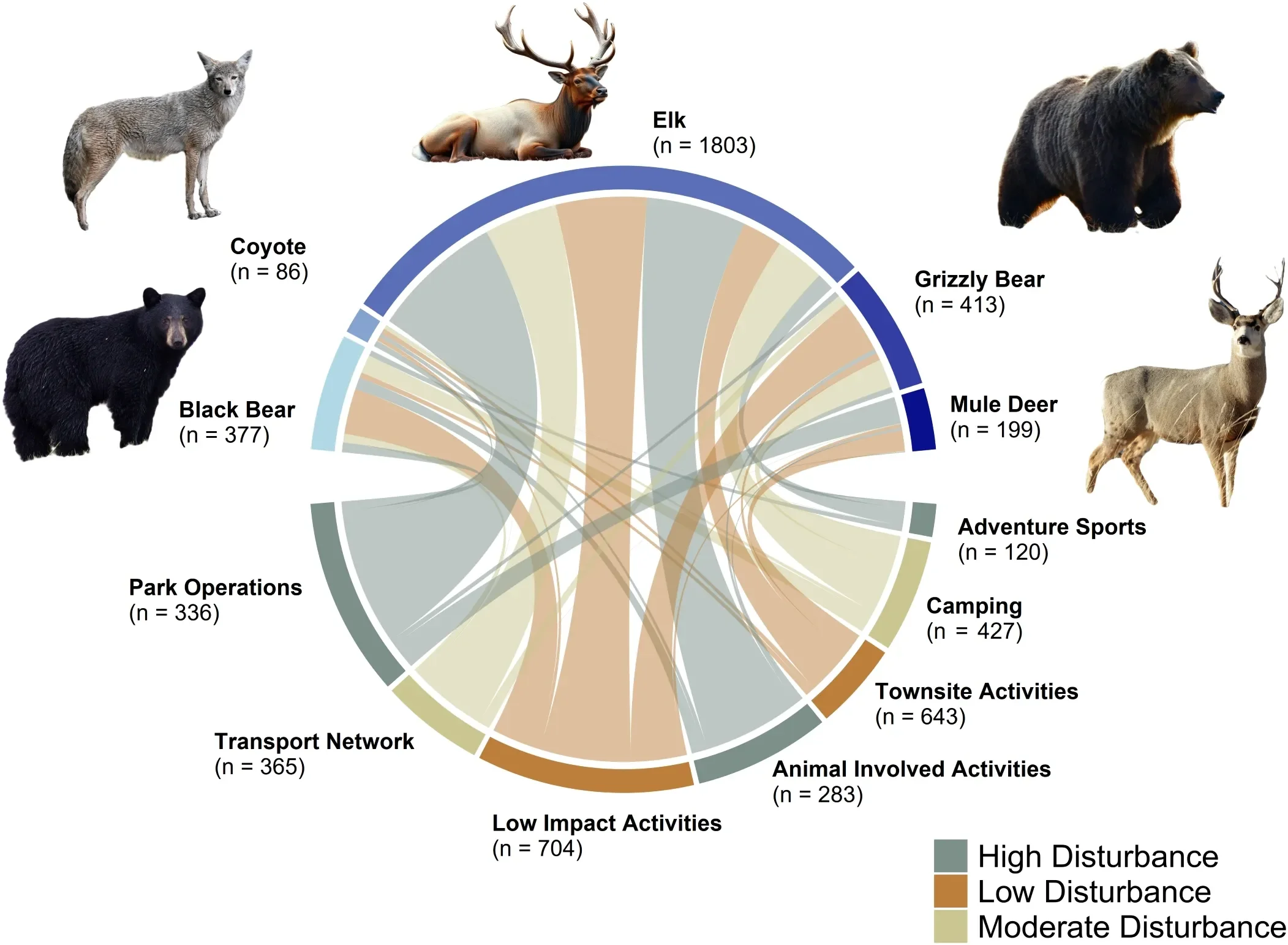
Patterns of aggressive human-wildlife encounters in Canada. Species are shown on the top, and recreational activities are shown on the bottom. Chords represent the frequency of aggressive encounters between each species and the corresponding recreational activity. Recreational activities are grouped into disturbance levels based on available literature
WILDLIFE AMBASSADOR WORDS OF WISDOM
Kananaskis Country is home to a lot of animals, including bears. Recreating safely in bear country means more than just knowing what to do in a bear encounter. It’s also understanding signs that bears are around, so that maybe those encounters can be prevented.
Bears are big enough that they almost always leave evidence that they’ve been present – if you know what to look for. Keeping your eyes peeled for this evidence can help you be aware if bears are present, and will decrease the risk that you’ll accidentally run into a bear. Every month we’re going to learn about some of the signs bears leave in the forest, and in this edition of Watching for Bear Signs by Derek Ryder, Volunteer Wildlife Ambassador & IGA Interpretive Guide, it is Broken Logs.
Research shows that two kinds of ants that are common here make up a good part of the early season diet of both Black and Grizzly bears. You might not think that a little ant would be of interest, and a single ant is no more interesting to a bear than to you or me. But a Red ant colony can contain hundreds of thousands of little ants, and their ground hills are obvious. Red ants also like living under dead and fallen trees. The Giant Carpenter ants that live in rotten wood in particular can have a LOT of calories in their colonies…Click here to read Derek’s full article about Broken Logs!

Click on this image of a broken log to read the full article!
FOOD FOR THOUGHT?
This past week a black bear attacked a three-year-old girl playing in her backyard in Maple Ridge, B.C. This incident made the headlines (see News section below) and really emphasizes the importance of never leaving children unsupervised in your backyard, and securing and removing attractants from towns, backyards, campsites and day use areas to avoid drawing bears in and getting them (and potentially people) into trouble. Another key point is that people should have bear spray at home near the door in an easily accessible location just in case they need it to deter a bear or other wildlife from their yard. RELATED ARTICLE: How to avoid a dangerous bear encounter, according to an expert.
Since the berry crop was not great this summer, fruit trees are the main attractants that will draw bears into residential areas and NOW is the time to remove the fruit before a bear points out the problem. Leaving fruit (such as crabapple, mountain ash, chokecherry and dogwood) in your trees can attract bears into residential areas, putting bears and people at risk. The best practice is to remove fruit bearing trees and shrubs from your yard, however if you decide to keep your fruit bearing trees and shrubs, please ensure the fruit is removed BEFORE it is ripe! Canmore residents can be fined for letting fruit and berries accumulate on trees and on the ground in their yards as per the Community Standards Bylaw. It is your responsibility to make sure that bears do not have a reason to linger in your yard, resulting in bears being relocated or killed.
There are still funds available for the Town of Canmore’s Fruit Tree Removal and Replacement Incentive Programs so take advantage NOW before the money runs out AND before you attract a bear into town and/or get a large fine! Applications are still open while limited funds are available so click here to apply now!
WildSmart has pruning shears and extendable pole saw pruners and fruit pickers that can be borrowed (free of charge) to assist Bow Valley residents in removing fruit and berry bushes from their property. Please send an email to resource@biosphereinstitute.org to make arrangements to borrow the fruit removal equipment.

These are common fruits/berries that attract bears into residential areas (pictured clockwise from top left); Chokecherry, Crabapples, Dogwood and Mountain Ash.
WILDLIFE IN THE NEWS
Marmot returned home to Kananaskis after hitching ride to Airdrie.
Australian man fined after black bear gets into food at Banff National Park campground.
‘There was just so much blood’: Mother describes bear attack on daughter.
Wrong bear killed by RCMP after girl attacked in Maple Ridge, B.C.
Parents speak out about dangerous bear encounters after attack on B.C. toddler.
Hiker escapes after being attacked by grizzly bear in backcountry near Pemberton, B.C.
Wayward mountain goat finds unlikely perch on outskirts of Kananaskis Country, relocated.
Experts reject claim black bear hunting with dogs helps caribou conservation.
Bear encounters in Canada: What's been happening and how can you reduce the risks?
CURRENT OPPORTUNITIES
The Biosphere Institute is hiring an Environmental Educator and Program Coordinator (Maternity Leave Contract) for our Future Leader Program, supporting the ecological literacy of children and youth in the Bow Valley. The Environmental Educator and Program Coordinator is responsible for organizing and delivering the Future Leaders programming including outdoor learning classes and field trips aligned with the Alberta curriculum, coordinating the Future Leaders Youth Council and maintaining strong relationships with funders while supporting the program’s fund development plan. The position will be based out of our office in Canmore.
This is a full-time maternity leave contract position, between 12 and 18 months in duration, with a start date of October 1, 2026. Click here for the full job description and requirements!
If you are interested in applying for this opportunity please email a resume and cover letter with the subject title “Future Leaders, Maternity Leave Contract” to education@biosphereinstitute.org by 5:00 p.m. MST on September 1, 2026.
AND NOW SOME PAWS-ITIVE NEWS
As part of our Trusted Messengers project, we worked with various community groups to develop conservation messages tailored to their peer or recreational user group. Messages were delivered through conversations, video, social media, or a combination. Below is an example of an infographic we created with the Canmore and Area Mountain Bike Association (CAMBA) to help mountain bikers understand that there are aspects of riding, namely speed, that present additional challenges compared to other user groups.

UPCOMING EVENTS
August 27 - Direct Outdoor Gear & Mountain View BearSmart are pleased to invite you to attend a bear and cougar safety and awareness presentation on Thursday, August 27 from 7-9pm at the Direct Outdoor Gear store in Sundre (102 6th Street NW, Sundre, AB).
Indoor presentation from 7-8pm will include:
how to id grizzly bears and black bears
the biology and behaviour of bears and cougars
managing attractants when hiking, camping, or living in bear country
how to avoid an encounter with a bear or cougar and how to act correctly when one has an encounter
how to use bear spray
From 8-9pm there will be outdoor bear spray training with inert spray in the parking lot (weather permitting). Space is limited so please register by emailing: info@directoutdoorgear.com or call: 403-636-4669.
Please bring a $10/person donation to support the Mountain View BearSmart Society and its volunteers, programs, and projects in their efforts to reduce human-bear conflicts in Mountain View and Clearwater counties. Click here for more info!
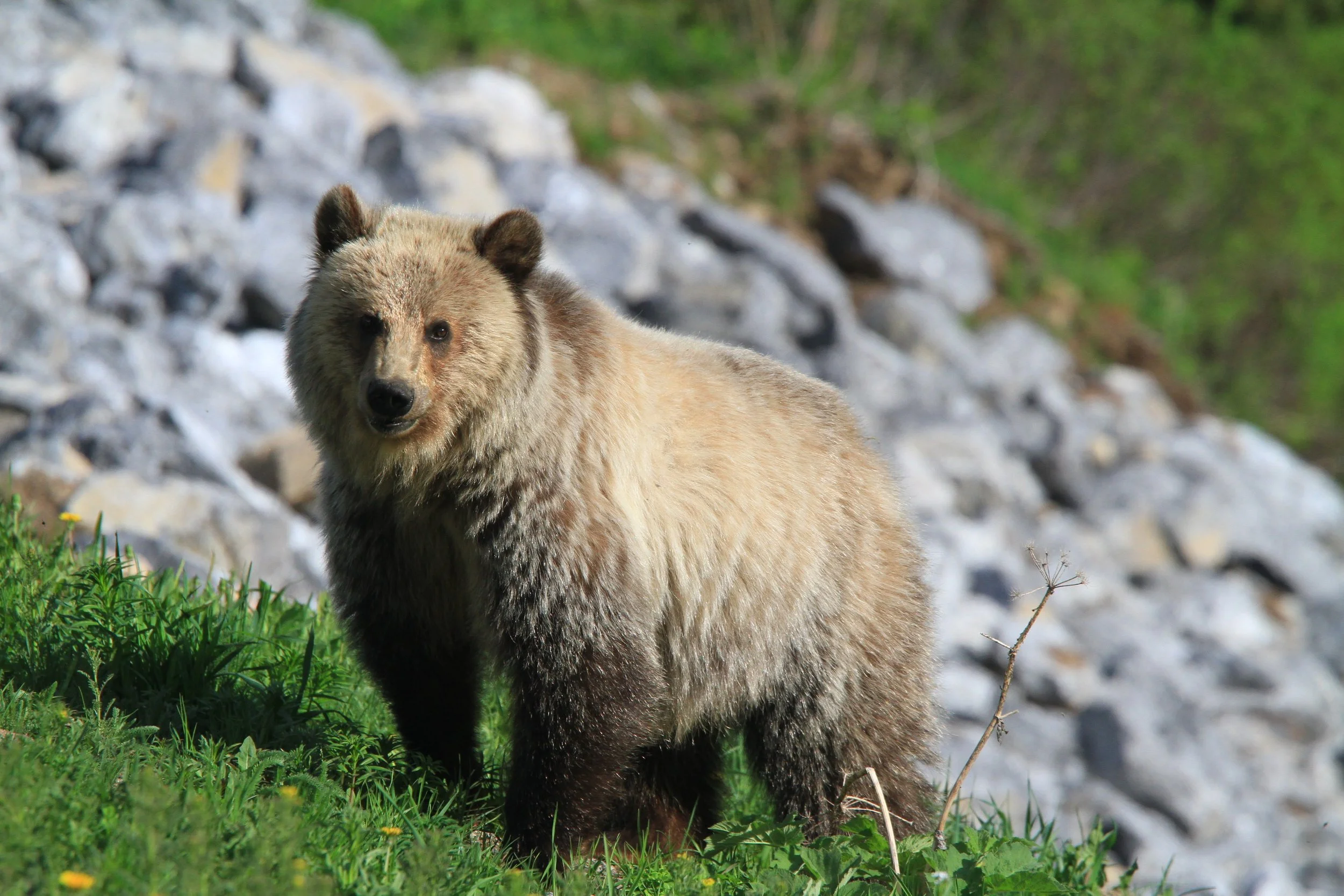
Please remember BEARS CAN BE ENCOUNTERED ANYWHERE, ANYTIME!
Report any sightings of a bear, cougar, wolf or any aggressive wildlife in Kananaskis Country or the Bow Valley to Kananaskis Dispatch at 403.591.7755